Postpartum hair loss
Why hair sheds after pregnancy? And what the evidence really says about light, massage, and scalp care
Postpartum hair loss
Postpartum shedding is usually temporary. While the hair cycle resets, a practical scalp-care routine can make the process feel less confusing and easier to manage consistently.
This article looks at what the evidence supports, what remains uncertain, and why LucenWave built a 5–10 minute at-home routine around red light, blue light, gentle massage, and fine-mist application.
Postpartum shedding can look dramatic — even when the follicles are still functioning normally
It often begins with ordinary clues: more strands in the shower, more hair in a brush, and a part that appears wider under bright bathroom light.
Dermatologists commonly describe this as postpartum telogen effluvium: a temporary increase in shedding associated with falling estrogen levels after pregnancy. During pregnancy, hormonal changes can keep more hairs in the growth phase. After delivery, a larger-than-usual group of hairs may move through the shedding cycle at roughly the same time.
The American Academy of Dermatology reports that shedding often peaks around four months after childbirth. For most women, normal fullness returns by the child's first birthday — sometimes earlier.1
That reassurance matters. Postpartum shedding is not usually the same condition as permanent pattern hair loss.
When to see a clinician
If shedding is patchy, painful, accompanied by scalp inflammation, or has not improved by the child's first birthday, a dermatologist can help determine whether something else is contributing.1
"Temporary" does not always feel reassuring
For many new mothers, the difficult part is not only the hair. It is the uncertainty — and the questions that come with it.
- Is this amount of shedding still within the expected postpartum pattern?
- Is an online "growth" product supported by evidence — or simply good marketing?
- Should the scalp be treated, massaged, left alone, or evaluated by a clinician?
- Can a routine be simple enough to maintain during an already demanding season?
The choice often feels like "do nothing" or "try everything." Neither is especially useful.
Because postpartum shedding commonly improves on its own, waiting can be medically reasonable. Yet waiting without a plan can leave people feeling passive and unsure.
The opposite response is to assemble an increasingly complicated routine: multiple serums, separate applicators, handheld massagers, supplements, salon appointments, and light-based devices — each making a different promise. The evidence rarely supports that level of certainty.
Red-light devices have been studied in people with androgenetic, or pattern, hair loss. Some controlled trials and systematic reviews report improvements in hair density with particular devices and protocols.23 But those findings cannot automatically be transferred to postpartum shedding — or to every product that emits red light.
Blue light has different biological properties and is used in dermatology for other purposes. It should not be presented as a clinically proven postpartum hair-regrowth treatment.
Massage can feel soothing and help spread a compatible scalp formula, but a pleasant sensation is not proof that follicles are being "reactivated." Oils may condition hair and reduce roughness, but they cannot override the hormonal timing of the postpartum hair cycle.
The more useful question is not "which product promises the fastest regrowth?"
It is: what kind of routine is realistic, transparent about its limits, and easy to follow while the hair cycle recovers?
A better routine starts by separating support from treatment claims
Postpartum shedding does not always require an intervention. It does, however, create a period when gentle handling, scalp comfort, manageable product application, and consistency can matter.
That shifts the goal. Instead of trying to "force" the hair cycle to move faster, a sensible at-home routine can focus on four practical jobs.
- 01Reach the scalp without aggressive pulling.
- 02Apply a compatible formula more evenly.
- 03Make massage comfortable and repeatable.
- 04Keep any light-based component within a clear, time-limited routine.
This is the problem LucenWave set out to simplify.
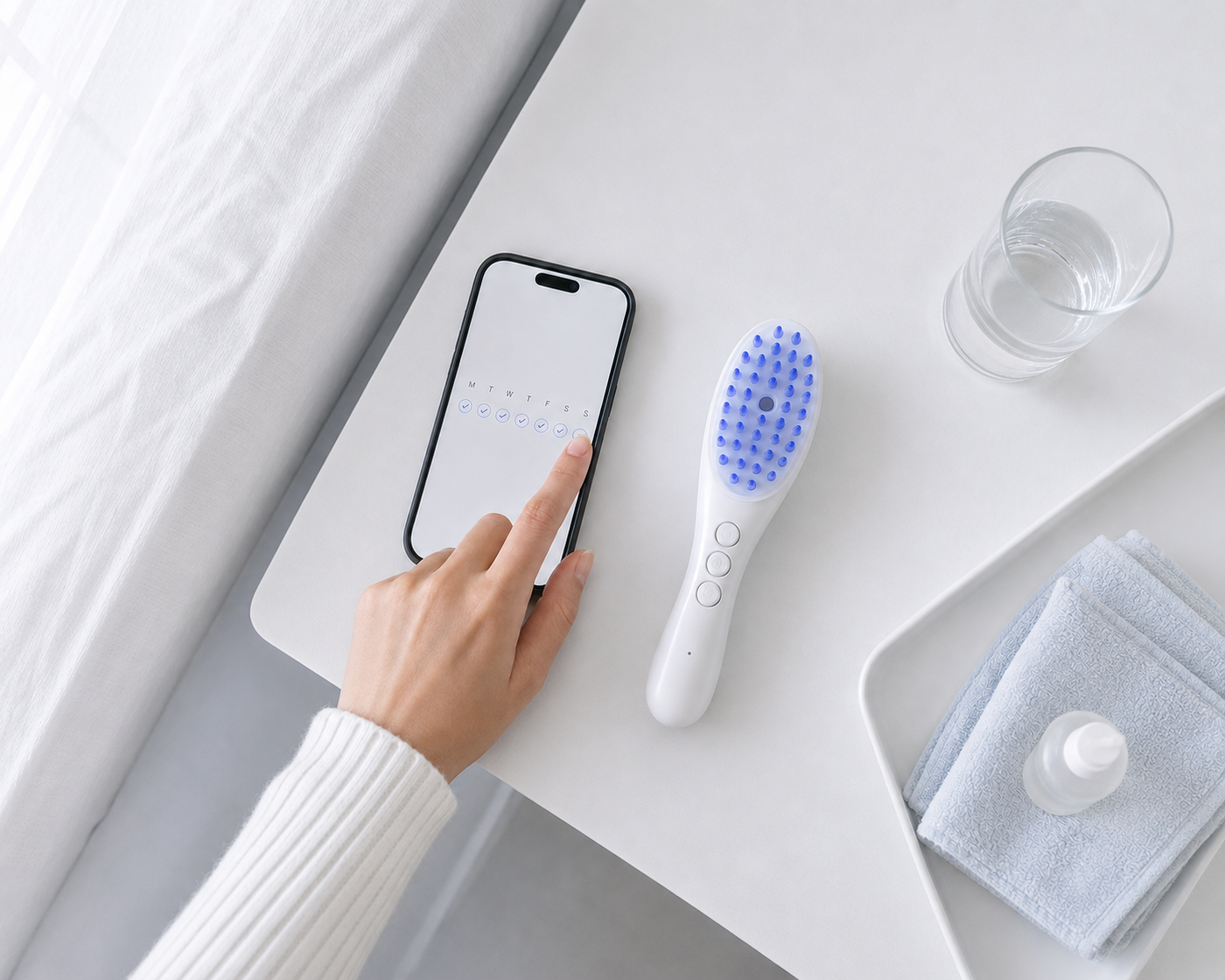
Meet the LucenWave Scalp Massage Spray Comb
LucenWave combines four commonly separated scalp-care steps in one cordless handheld tool.

What the routine changes immediately
Visible hair-cycle changes take time. The practical experience of a routine can change on the first use.
Light care, gentle vibration, sectioning, and formula application happen with the same handheld device.
Official LucenWave guidance recommends 5–10 minutes, several times per week, beginning with shorter sessions and adjusting for comfort.
The fine mist distributes a compatible lightweight formula while the brush moves across the scalp. Thick oils, creams, or products containing particles should not be placed in the reservoir.
Flexible comb teeth help separate strands so the device can reach the scalp without requiring the hair to be pulled tightly aside.
USB-C rechargeable, with a quiet vibration motor and travel lock. Usable on dry or slightly damp hair.
LucenWave recommends comparison photographs under the same lighting, distance, angle, and hairstyle — reducing the chance that ordinary differences in styling or photography are mistaken for a biological change.
30-day returns subject to hygiene and product-condition requirements · three-month limited warranty · email support. Because this is a scalp-contact personal-care device, opened products may be subject to hygiene-related return restrictions unless defective, damaged, incomplete, or incorrect. Review the current return policy →
What the evidence says about red light — and where the limits are
Red-light approaches for hair are usually discussed under the broader term photobiomodulation, or PBM. Researchers have proposed that light may influence cellular signaling around the follicle, but a plausible mechanism is not the same as a proven clinical result.
The strongest evidence concerns pattern hair loss
Controlled trials and systematic reviews have reported improvements in hair density with certain low-level light devices used for androgenetic, or pattern, hair loss.23 Those findings are encouraging — but they have clear limits.
- —The participants had pattern hair loss, not ordinary postpartum shedding.
- —The studied devices used their own wavelengths, output, coverage, dose, and treatment schedules.
- —The trials lasted months, not days.
- —The findings do not establish the effectiveness of the exact LucenWave product.
Wavelength alone does not prove effectiveness
Seeing "630 nm" or "660 nm" on a product page does not tell the whole story. Irradiance, exposure time, coverage, distance, contact, and total delivered dose also matter. That is why research performed on one device cannot automatically be treated as proof for another simply because both emit a similar colour of light.
What about blue light?
Blue light has different biological properties and is studied in dermatology mainly for applications other than hair regrowth. LucenWave positions its 415 nm blue-light mode as part of a fresh, balanced-feeling scalp-care routine — not as a clinically proven treatment for postpartum shedding.
Why testimonials need context
Postpartum shedding often improves naturally as hormone levels and the hair cycle normalise. If improvement happens after someone starts a product, the timing alone cannot prove that the product caused the change. Personal experiences can still be useful, but they should be read as individual observations rather than controlled clinical evidence.
One session, step by step
People who are pregnant, nursing, taking photosensitizing medication, or managing a skin or medical condition should consult a qualified clinician before beginning a new light-care routine.
- 01Mist. A fine spray delivers oil to the scalp rather than the strands.
- 02Part. The teeth separate hair so the LEDs sit against skin.
- 03Expose. Red and blue wavelengths pass over the treated area.
- 04Massage. Gentle vibration works the scalp while the comb moves.
People who are pregnant, nursing, taking photosensitizing medication, or managing a skin or medical condition should consult a qualified clinician before beginning a new light-care routine.
What customers talk about most: usability and consistency
Excerpts from verified reviews.

“This is the first scalp routine I've actually kept up with after having my baby. My hair growth after 3 months. I love this!”

“The mist makes it so easy, the oil goes exactly where I want it instead of coating all my hair. I’m even starting to notice little baby hairs coming in around my part.”

“Five calm minutes in the evening it doesn’t feel like another chore, and I’m already seeing less shedding and new baby hairs growing in.”
Table 1 — the meaningful difference is integration, not a promise of faster regrowth
Categories, not specific competitor models. Costs are typical retail ranges.
Start with the simplest version of the routine
LucenWave Comb + complimentary Growth Oil
Listed at $99 for the device — a 40% reduction under the current offer.
Price, gift, shipping threshold, availability, and warranty may change. See the current product page for live offer details.
Postpartum shedding usually needs time. A scalp-care routine needs clarity.
The most important fact is also the most reassuring: postpartum telogen effluvium is commonly temporary, and most women regain their usual fullness as the hair cycle normalises.1
LucenWave does not change that biology on command, and it should not replace medical evaluation when shedding is persistent, patchy, painful, or otherwise concerning. What it offers is more practical.
For someone looking for certainty overnight, this is not a miracle solution. For someone looking for one carefully designed tool that makes an at-home routine easier to follow, LucenWave offers a considered place to start.
See LucenWave and current pricing →
Disclosure & notes
This article is a sponsored editorial produced in partnership with LucenWave. Research described refers to low-level light therapy in general, not to results produced by this specific device.
Source notes
- 1American Academy of Dermatology Association. Hair loss in new moms: dermatologist tips.
- 2Fan SMY, et al. Efficacy and safety of a low-level light therapy for androgenetic alopecia. Dermatologic Surgery, 2018.
- 3Liu KH, et al. A systematic review and meta-analysis of home-use low-level light therapy for pattern hair loss. 2021.
- 4LucenWave. Scalp Massage Spray Comb — official product page.
- 5Federal Trade Commission. Health Products Compliance Guidance. 2022.